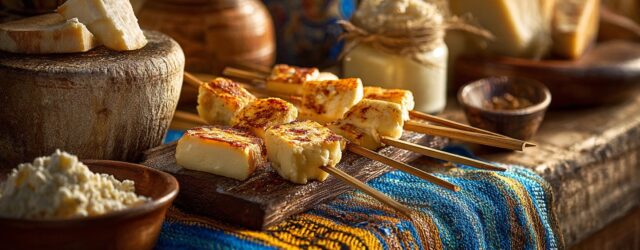
Brazil has a lot more cheese than the cheese bread. Four to know: a firm cheese that gets grilled on a stick at the beach, a fresh, mild cheese, an aged raw-milk cheese from the mountains of Minas Gerais, and a creamy spread that ends up on pizza. Here is what each one is, plus the Portuguese you need to ask for them.
Queijo coalho
Coalho (say “kwah-LYOH”) is the cheese of Brazil’s Northeast. The word coalho means rennet, so the name is simply “rennet cheese”. It is made from a semi-cooked curd and is usually eaten fresh or after a short ageing, according to a study from the Federal University of Paraíba (in Portuguese). It is a semi-firm, elastic cheese with a mild, slightly salty and slightly tangy taste and a thin rind. Much of it is still made by hand, mostly in the states of Ceará, Rio Grande do Norte, Paraíba and Pernambuco.
What coalho is famous for is the grill. On the beaches of the Northeast it is cut into slices, put on a stick and cooked over hot coals until it is golden outside and soft inside. It holds its shape well over heat, which is why it works on a stick. If you can’t find it, halloumi is the closest thing in most US stores, though the taste is different.
Queijo minas: frescal and meia cura
“Queijo minas” means cheese from the state of Minas Gerais, and it comes in a few styles. Two are easy to tell apart. Frescal (fresh) is not aged at all, so it is soft, moist and mild, and it is eaten soon after it is made. Meia cura (half-cured) is aged lightly, so it is firmer, with a stronger taste, and it melts less. It is the cheese traditionally used in pão de queijo. Producers disagree on exactly how many days or weeks “meia cura” means, so treat any number you read as a rough guide (Itatiaia, in Portuguese, explains the differences).
Queijo canastra
Canastra is the best-known of the craft cheeses of Minas Gerais. It comes from the Serra da Canastra region and is made from raw milk. In 2008 the Brazilian heritage agency IPHAN registered the traditional way of making Minas cheese, covering the cheeses of Serro, Canastra and Salitre. Slow Food lists it in its Ark of Taste, which includes a description of how it is made.
Requeijão and Catupiry
Requeijão cremoso is a soft, mild, spreadable cheese that Brazilians put on bread, stuff into snacks and use on pizza. Catupiry is the best-known brand, started in 1911 in Lambari, Minas Gerais, and its name has become the everyday word for the product, much like “Kleenex” in the US. Accounts of the founders’ names differ between sources, so I’ll leave those out. Its big break came in the 1970s, when it was promoted to pizzerias (CNN Brasil, in Portuguese).
Cheese words in Portuguese
- queijo: cheese
- leite: milk
- pão: bread (plural: pães)
- coalho: rennet
- fresco: fresh
- curado: aged
- derreter: to melt
- assar: to bake or roast
- Quero mais queijo, por favor.: I want more cheese, please.
Want to read more Portuguese?
My other business, Omorphos, publishes graded readers for people learning languages: stories written at a set reading level.